

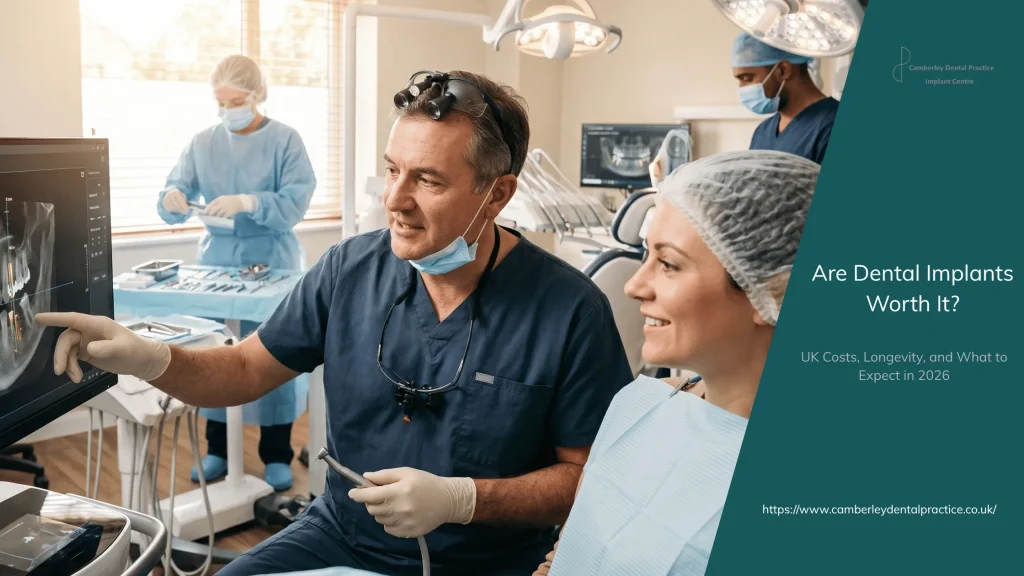
Quick Answer: Dental implants are a permanent solution for missing teeth, consisting of a titanium post that fuses with your jawbone. They have success rates of 95% or higher and can last 25 years to a lifetime with proper care. While dental implants cost more upfront—typically £2,000 to £3,000 per tooth in the UK—their durability often makes them more cost-effective than dentures in the long run.
Let’s dive into the details now.
If you have a missing tooth, you might feel self-conscious when you smile or struggle to eat your favourite foods. You aren’t alone. Thousands of people look for permanent ways of replacing missing teeth every year. Most people want to know whether investing in dental implants truly adds years to their smile.
What are dental implants?
According to the British Society of Periodontology, a dental implant is an artificial replacement for a tooth root. Unlike dentures, which sit on top of the gums, an implant is placed directly into the jawbone. It is made of titanium, a metal that the human body accepts very well.
Whether you are looking for single tooth implants or a full arch replacement, the goal is the same: to restore your oral health and confidence. Because they function like natural roots, they provide a level of stability that other treatments simply cannot match.
How do dental implants work?
The process begins with a bespoke treatment plan. During dental implant treatment, we will place a titanium post into the bone. This triggers a biological process where your jawbone grows around the post, gripping it tightly. Don’t worry: this procedure won’t be painful as we will administer local anaesthesia to make you pain-free.
A crucial requirement for the success of dental implants is a high-quality jawbone. This is because the implants anchor themselves in the jawbone. If sufficient bone quality or density is not available, it may jeopardize the implant’s long-term success.
In the jawbone, in some cases, if the bone is too thin, we may perform bone grafting or a sinus lift to ensure there is a solid foundation for the implant. Once the area heals, a custom-made crown is attached. The result looks and feels just like a natural tooth.
Why are dental implants so successful?
Modern dentistry has turned this into a very predictable science. In the UK, success rates for these procedures are consistently high. According to the Association of Dental Implantology, most patients enjoy a complication-free experience.
There are a few reasons for this:
- Medical Technology: Titanium is highly compatible with the human body.
- Whole-Body Wellness: We now understand the link between a healthy mouth and heart disease. By keeping your mouth clean, you support your overall health.
- Longevity: As human longevity increases, people need dental solutions that can keep up with active, healthy lifestyles.
How long do dental implants last?
One of the biggest benefits of implants in the UK is their long life. While a dental bridge might need replacing every decade, an implant is designed for a life expectancy that matches your own.
The titanium post can last 25 years or more. In many cases, it is a permanent fix. To ensure your implants have a long life, you simply need to maintain good hygiene and visit your dental hygienist regularly.
How many teeth can dental implants replace?
The versatility of this treatment is incredible. You don’t necessarily need one implant for every single missing tooth:
- Single Gap: a single-tooth gap is restored using a single dental implant that supports a porcelain crown.
- Multiple Gaps: if you have one or more teeth missing, your dentist will replace them with implant-supported bridges or overdentures. You don’t necessarily require an implant for each missing tooth. Instead, two implants can support a bridge of several teeth.
- Full Arch: If you have lost all your teeth, a full arch of new teeth can be secured by just four to six implants.
This prosthesis is known as an All-on-4 denture. It consists of a complete fixed bridge that is supported by four (or six) implants placed at strategic locations in each jaw. Another benefit of an All-on-4 implant is that they are sometimes suitable for patients who don’t have sufficient jawbone in the back of their jaws.
What are the benefits of dental implants?
Choosing an implant over a traditional bridge or denture offers several advantages that impact your daily life and long-term wellness. Here are the primary benefits:
- Bone Preservation: Unlike other options, implants stimulate the jawbone, preventing the bone loss that usually occurs when a tooth is missing.
- Natural Appearance: They are designed to match the colour and shape of your natural teeth perfectly, making them virtually indistinguishable.
- Improved Speech: You don’t have to worry about “clicking” sounds or teeth slipping, allowing you to speak with total confidence.
- Ease of Eating: Because they are anchored in the bone, you can bite into apples or chew steak just as you would with natural teeth.
- Protecting Existing Teeth: A single dental implant doesn’t require the teeth on either side to be ground down, which helps preserve your remaining natural teeth.
- Convenience: There are no messy adhesives or the need for overnight soaking; you simply brush and floss like normal.
Are you ready for a permanent smile?
Missing teeth can affect your health and your happiness. If you are tired of gaps or loose dentures, it is time to explore your comsetic dentistry tooth replacement options with a team that cares about your long-term wellness.
Book your new patient consultation online today at Camberley Dental Practice. Let us help you find the right solution for your smile.